
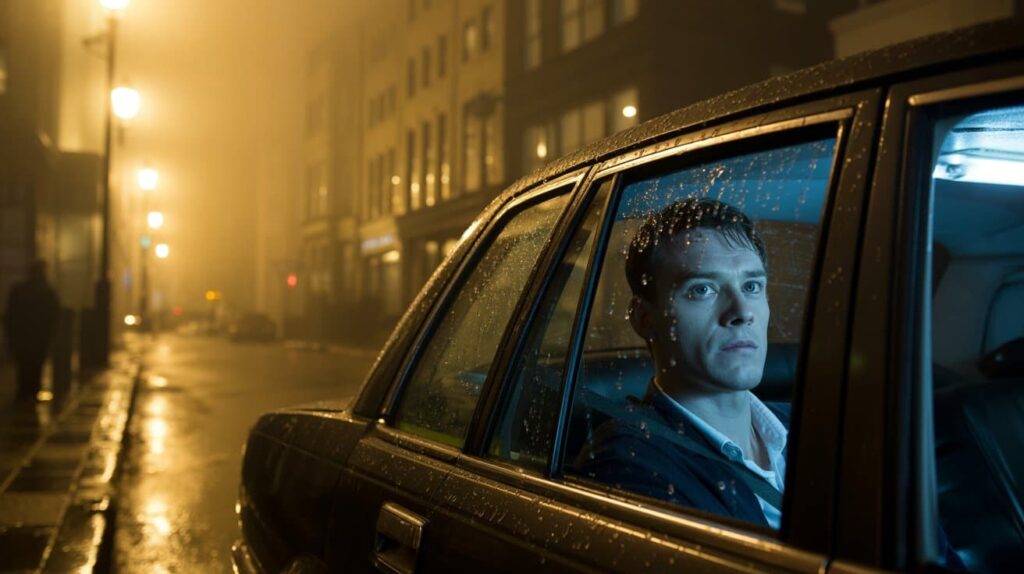
The rain in London wasn’t just water falling from a grey sky; it was a relentless, icy onslaught that felt like jagged needles against the skin. It was 3:14 AM—the “Devil’s Hour”—and the narrow, ancient alleys of Whitechapel were submerged in a thick, charcoal fog that tasted of wet soot and old secrets. The streetlamps flickered with a dying yellow light, casting long, distorted shadows that seemed to crawl along the damp brick walls like living, breathing things.
Detective Elias Thorne sat inside his black sedan, his eyes fixed on the rhythmic motion of the wipers. He didn’t move. He didn’t even blink. Elias was a man who lived in the spaces between seconds. While other detectives rushed into crime scenes with guns drawn and adrenaline pumping, Elias waited. He believed that every crime had a “pulse”—a rhythmic heartbeat that, if caught early enough, could lead you straight into the mind of the monster.
His phone vibrated on the leather seat, the buzz sounding like a swarm of angry hornets in the silence. No caller ID. He answered, but didn’t speak.
“The stage is set, Elias. Don’t be late for the first movement,” a distorted, metallic voice whispered. The line went dead before Elias could trace the breath of the speaker.
Elias stepped out into the deluge. The heels of his bespoke Italian boots clicked sharply against the wet cobblestones—tap, tap, tap—a rhythm that echoed through the empty street like a ticking clock. He adjusted the collar of his charcoal trench coat and entered an old, Victorian-era violin workshop at the end of the alley. The wooden sign above the door, shaped like a weathered cello, swung violently in the wind, its rusty hinges screaming like a wounded animal.
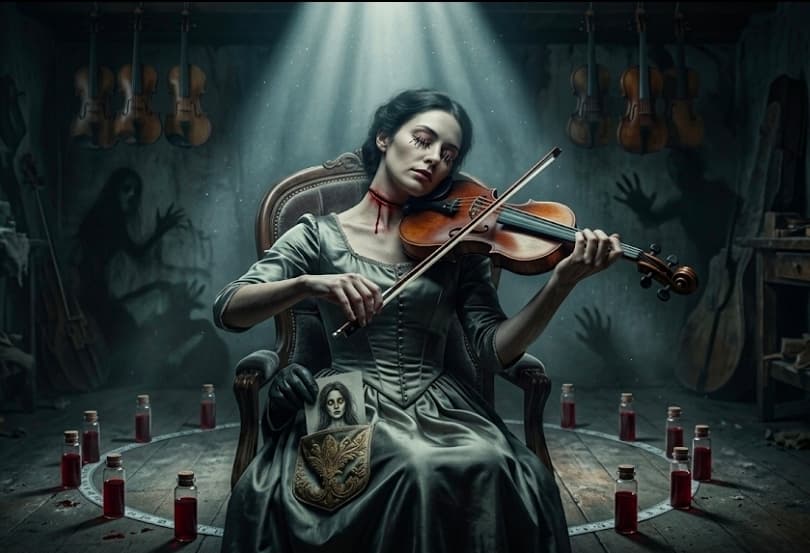
Inside, the air was heavy and stagnant. It smelled of aged spruce wood, bitter rosin, and something sweet yet metallic: fresh, oxygenated blood. The workshop was a graveyard of broken dreams; skeletal violins hung from the ceiling by thin wires, swaying gently in the draft. In the center of the room, under a single, harsh spotlight that seemed to pull the darkness closer, sat the victim.
She was Isabella Rossi, the world’s most celebrated young violinist. She was draped over a velvet-backed chair, her posture unnaturally, painfully perfect. Her left hand was clamped around the neck of a 17th-century Stradivarius; her right hand held the bow mid-stroke across the strings. At first glance, she looked like she was in the middle of a soulful, silent concerto.
But Isabella was dead. Her throat had been opened with a single, horizontal cut so clean it looked surgical, almost artistic.
“Don’t touch a single thing,” Elias commanded Inspector Miller, who stood by the door, his face the color of spoiled milk.
Elias began his slow, methodical walk around the body. Twelve small glass vials were arranged in a perfect geometric circle around the chair. Each vial was filled to the brim with dark, crimson blood. Elias pulled a silver measuring tape from his pocket. The gap between each vial was exactly 3.14 inches.
”Pi,” Elias whispered, the word trailing off into the shadows. “The mathematical constant for a circle. He’s telling us his work is infinite. No beginning, no end. A cycle of perfection.”
Isabella’s eyes were the real “quirk.” They had been stitched shut with fine silver thread—the kind used by luxury tailors in Savile Row. Elias used sterilized tweezers to pull a small, hand-drawn charcoal sketch from the decorative pocket of her silk dress. It showed Isabella exactly as she sat now, but in the drawing, her eyes were wide open and glowing with a terrifying, golden light. At the bottom, in elegant, swirling calligraphy, were the words: “The first movement is complete. The Conductor demands an encore.”
Suddenly, a low, vibrating hum rose from the floorboards. It wasn’t a sound at first; it was a feeling in the marrow of Elias’s bones. A violin was playing—mournful, deep, and haunting—coming from inside the walls themselves. Elias grabbed a heavy iron crowbar from a workbench and smashed the drywall. Wood and plaster exploded. Behind the lath was an ancient, brass-horned gramophone.
As the needle scratched across the vinyl, Elias realized the recording had been altered. Every fourth beat, the music glitched into a sickening distortion, and a voice—cold, mechanical, and devoid of any human warmth—would whisper:
“Elias… do you hear the heartbeat? It’s slowing down. 60… 58… 55…”
Elias noticed a tiny copper wire running from the glass vials to a pressurized detonator hidden under the chair. The gramophone’s vibration wasn’t just music; the frequency of the needle was acting as a sonic timer.
“Everyone out! Now!” Elias yelled, grabbing Miller by the belt and throwing him through the front window just as the vials shattered.
There was no fire. Instead, there was a blast of pure sound—a frequency so high it shattered every window on the block and sent the officers outside to their knees, blood leaking from their ears.
In the ringing silence that followed, Elias looked up at the skylight. For a split second, he saw a silhouette against the moon. A man in a long, flowing coat, holding a silver conductor’s baton. The figure didn’t run. He bowed—a slow, graceful, mocking bow directed straight at Elias—before vanishing into the London fog.
The Forensic Echo
Back at the precinct, the atmosphere was suffocating. Elias ignored the ringing in his ears and the concerned looks from his colleagues. He spent the next eight hours buried in the “Cold Archive”—a basement room filled with files that the city wanted to forget. He was looking for a ghost.
His mind kept flashing back to his university days. He remembered a student who sat in the back of the forensic lecture hall, always sketching, always listening to classical music through heavy headphones. Julian Vane.
Julian was a musical prodigy who had switched to forensics because he claimed that “science was the only way to truly understand the rhythm of a dying soul.” He had been Elias’s only rival. Ten years ago, Julian was supposedly killed in a lab explosion that Elias himself had investigated. The body had been charred beyond recognition, identified only by a silver tuning fork found in the ashes.
Elias pulled the old Vane file. He laid the new charcoal sketch next to Julian’s old crime-scene drawings. The technique was identical—the heavy use of cross-hatching, the way the shadows leaned at a three-degree angle. But there was more. In the new sketch, hidden in the intricate shading of the violin strings, was a tiny, microscopic letter ‘V’.
”He didn’t die,” Elias muttered, his voice raspy from the cold. “He choreographed his own death.”
The next morning, the “encore” arrived. It was found at the London Mathematical Society. The victim was Professor Alistair Vaughan, a genius in fluid dynamics. His body was pinned to a massive chalkboard, his arms and legs stretched out like a human compass. His own blood had been used to draw complex, spiraling equations across the floor.
The “quirk” here was even more disturbing. The professor’s tongue had been removed and replaced with a silver tuning fork. When Elias struck it with his pen, it didn’t just vibrate; it hummed a perfect “A” note at exactly 440Hz.
”He’s tuning the city,” Elias told Miller, who was now wearing heavy earplugs. “If you plot the workshop and this library on the map, and follow the frequency of the notes, the next location isn’t a guess. It’s a mathematical certainty.”
Elias realized Julian was building the Diabolus in Musica—the Devil’s Interval. It was a combination of notes so dissonant that the medieval church had once banned it, believing it could summon demons. Julian wasn’t just killing people; he was trying to play a symphony using the geography of London as his instrument.
The Devil’s Interval
The third note led Elias to the Royal Observatory in Greenwich. The fog was so thick here that the Great Equatorial Telescope looked like a giant, metallic finger pointing toward a silent god.
Elias entered the dome alone. He had ordered the police to stay back. He knew that Julian Vane wouldn’t trigger his traps if he felt the “audience” was too crowded. Inside, the air was freezing. The giant telescope had been moved. It wasn’t pointed at the stars; it was pointed downward, toward the city’s main gas refinery in the distance.
In the center of the rotating floor, tied to the massive iron gears of the telescope, was Dr. Aris.
Aris had been Elias’s mentor, the man who had taught him that forensics was the ultimate truth. Seeing him now, frail and terrified, sent a surge of raw fury through Elias.
”Elias, leave!” Aris gasped, his voice barely a whisper. “The gears… they’re pressure-sensitive. If you move toward me, the telescope shifts. It’s aimed at the refinery. One spark… and the ‘Crescendo’ begins.”
”A bit late for a rescue, isn’t it, Elias?” a melodic, cultured voice echoed from the darkness of the gallery.
Julian Vane stepped into the dim light. He looked immaculate in a midnight-blue tuxedo, his hair slicked back, his eyes sparkling with a feverish, intellectual madness. He held a silver baton that caught the moonlight.
”You faked it all,” Elias said, his hand hovering near his holster, but his eyes scanning the gears. “The explosion, the body… why?”
”Because the world is out of tune, Elias!” Julian shouted, his voice suddenly rising in pitch. “Look at this city! It’s a mess of uncoordinated noise. People screaming, cars honking, lives being lived without any rhythm. I am the only one who can bring order to the chaos. I am the Conductor!”
Julian explained his “philosophy.” He didn’t see himself as a murderer. He saw himself as a “Catalyst.” He targeted people whose lives were “dissonant.” Isabella had been using her fame to cover up a string of plagiarized compositions. The professor had been selling fake data to the government.
”And Aris?” Elias asked, his voice steady. “What was his sin?”
Julian laughed, a high-pitched, musical sound. “Oh, Elias. Your dear mentor is the biggest liar of them all. He didn’t just cover up my ‘death.’ He covered up the truth about your own father. Your father didn’t die in a car accident. He was the one who funded my early experiments. He wanted to see if science could capture the soul at the moment of death. Aris knew. He protected your father’s ‘reputation’ by letting me vanish.”
Elias felt the ground beneath him turn into liquid. His entire life—his career, his morality, his search for the truth—was built on a foundation of lies. He looked at Aris, who could only look away in shame.
”Now,” Julian said, raising his baton. “The finale. I have rigged the city’s underground gas lines to vibrate at the Devil’s Interval. When I strike this gear, the resonance will travel through the pipes. One note, Elias. And London will become a beautiful, fiery masterpiece.”
The Final Discord
Elias looked at the baton. He looked at the gears. He knew he couldn’t outrun the vibration. He couldn’t shoot Julian before he moved his hand. Julian was too fast, too obsessed.
But Elias remembered the “quirk” of the first sketch. He remembered Julian’s obsession with perfection.
But Elias remembered the “quirk” of the first sketch. He remembered Julian’s obsession with perfection.
”You’re a failure, Julian,” Elias said quietly.
Julian froze, his baton inches from the gear. “What did you say?”
”The sketch of Isabella,” Elias pulled the paper from his pocket. “I showed it to the forensics team. We ran a digital scan on the shading. You missed the angle of the moon by three degrees. Your ‘Pi’ circle was off by a fraction of a millimeter. You think you’re a conductor? You’re just a student who can’t do basic geometry.”
Julian’s face went from pale to a deep, bruised red. “You’re lying! My work is perfect! It is mathematically divine!”
”Check it yourself,” Elias tossed the sketch onto the rotating floor, far from the gears but close to Julian.
For a split second, Julian’s psychological compulsion—his absolute need for perfection—overrode his plan. He lunged for the paper, his eyes wide with panic as he scanned his own drawing.
In that heartbeat of distraction, Elias didn’t aim for Julian. He aimed for the silver tuning fork hanging around Julian’s neck.
Crack.
The bullet struck the fork, causing it to shatter. But the impact sent a massive, discordant vibration through Julian’s chest. At the same time, Elias lunged at the telescope’s control panel and reversed the gears.
The heavy iron weights Julian had rigged swung backward. Julian, still clutching the “imperfect” sketch, was caught in the path of the massive rotating lens. He didn’t scream. He just looked at Elias with a look of pure, heartbroken betrayal as the gears jammed, pinning him against the cold glass of the telescope.
The “Crescendo” never happened. The gas lines remained silent.
The Aftermath of Silence
The police arrived ten minutes later. Dr. Aris was untied, but he wouldn’t look Elias in the eye. Julian Vane was taken away in a specialized medical unit; his ears had been permanently deafened by the frequency of the bullet hitting the tuning fork. The Conductor was now trapped in a world of absolute, eternal silence.
Elias stood on the balcony of the Observatory, watching the sun rise over the Thames. The city was waking up. The noise was starting again—the honking, the shouting, the chaotic rhythm of millions of lives.
He pulled his father’s old watch from his pocket. He looked at it for a long time, then opened the back casing. Inside, hidden behind the gears, was the same ‘V’ symbol. Julian had been telling the truth.
Elias didn’t feel the need for a “perfect” ending. He didn’t want to fix the city’s rhythm anymore. He realized that the “quirk” of life wasn’t its harmony, but its beautiful, messy discordance.
He walked back to his black sedan. On the dashboard, he saw a single white rose Julian had left there days ago. Elias picked it up, smelled its sweet, fading scent, and then crushed it in his hand.
He started the engine. The radio flickered to life, playing a distorted violin track. Elias didn’t change the station this time. He just drove into the noise.